
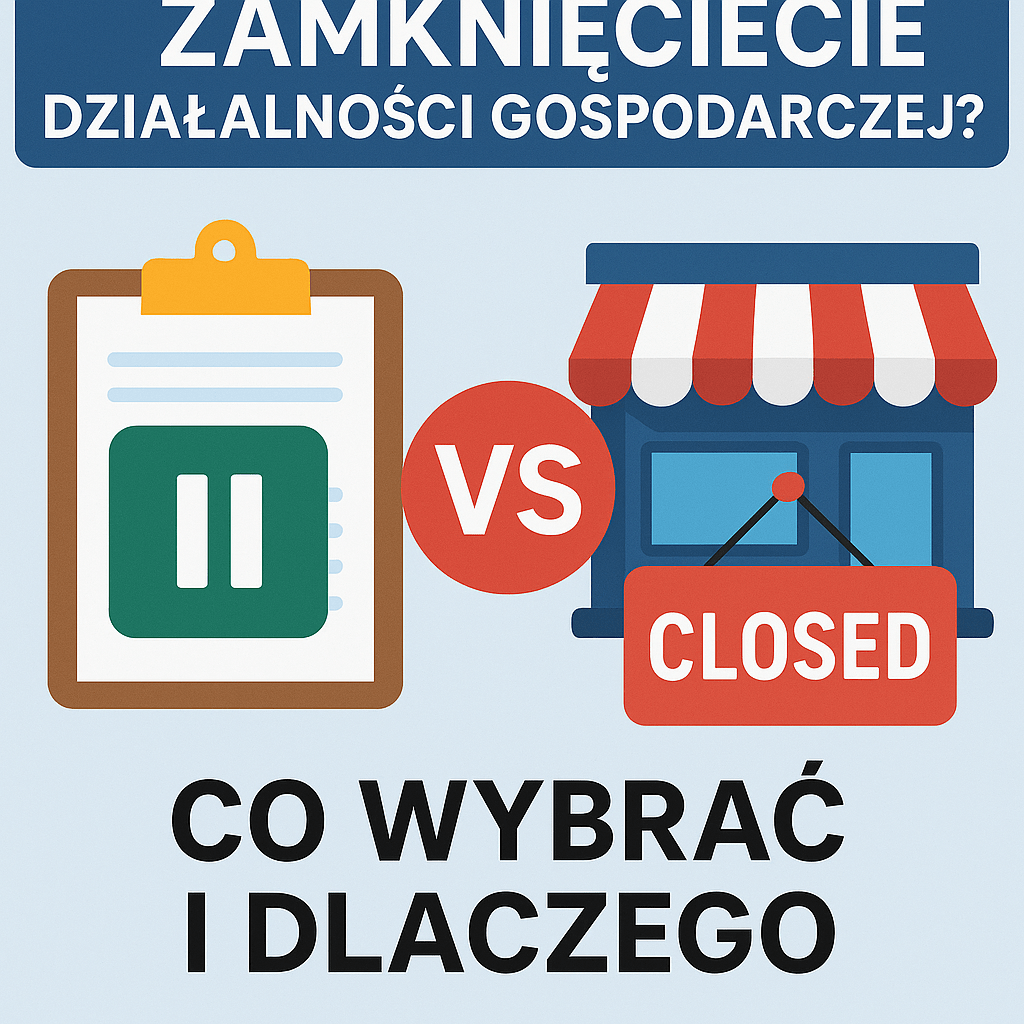
Suspension or closure of business activity- JDG? What to choose and why
Running your own business in Poland is not only about the satisfaction of independence and realising your own ideas, but also about responsibilities, costs and formalities. However, life sometimes forces entrepreneurs to take a break from business – due to relocation, health problems, a change of industry or the seasonal nature of their services. In such a situation, a key question arises: is it better to suspend business activity or close it down completely?
Closing a business – definitive termination of business
Closing a business in CEIDG means removing the company from the register and terminating its legal existence. This is a final decision that should only be made when you are certain that you will not return to running the business. This most often applies to situations such as moving abroad permanently, taking up permanent employment or a complete change of career plans.
However, it should be remembered that after closing down a business, any return to business will require re-registering the company from scratch. What is worse, the entrepreneur then loses the right to social security (ZUS) relief, including preferential contributions for 24 months. For foreigners conducting business in Poland, closing a company may also mean the expiry of their residence card issued on this basis.
Suspension of business activity – a safe break in business
Suspension of business activity can be compared to pressing the ‘pause’ button. The company still exists in the CEIDG register, but the entrepreneur does not sell and does not generate income from this activity. The biggest advantage is that during the suspension period, you do not have to pay social security contributions, and you can resume your business at any time by submitting a simple application, which can also be done online.
An additional advantage of suspension is that you retain your right to social security relief. If you are benefiting from the ‘start-up relief’ or ‘small social security’ schemes, the preferential period is simply paused, and after resumption you can complete the remaining months of lower contributions. For foreigners, suspending business activity is also safer, as their residence card remains valid.
Example
Anna ran a small dressmaking workshop. Her husband received a one-year job offer abroad. Anna did not know if she would want to return to running her business after her husband’s return, but she did not want to close this option. So she chose to suspend her business activity.
Thanks to this, she did not pay social security contributions during her entire stay abroad, her residence card remained valid, and after her return, she was able to resume her business in one day and continue to benefit from social security relief. If she had decided to close her business, she would have lost all these privileges.
How to make a decision?
The choice between suspending and closing your business depends primarily on your plans for the future. Closing your business makes sense if you are sure that you will never return to business. However, if there is even a small chance that you will want to run your business again, suspending your business is a safer and more cost-effective solution.
Suspension costs nothing, protects your social security benefits, allows you to keep your residence card valid and gives you full flexibility. In practice, it takes just a few clicks, which can save you a lot of paperwork and money in the future.